New Decagon Discovered at Saturn's South Pole Sparks Scientific Curiosity
Key Takeaways
- A decagon has appeared around Saturn's south pole, intriguing scientists.
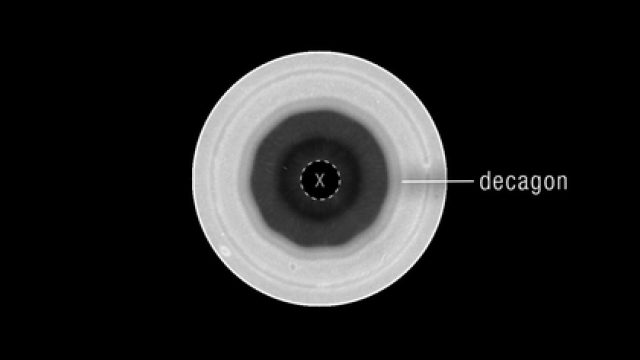
- This ten-sided shape is thought to be an atmospheric wave pattern.
- Similar patterns were previously observed at Saturn's north pole.
- The phenomenon raises questions about Saturn's weather dynamics.
- This discovery may enhance our understanding of gas giants.
Understanding Saturn's Decagon
Saturn never ceases to amaze scientists with its complex atmospheric behaviors. In a groundbreaking finding, researchers have identified a newly formed decagon surrounding Saturn's southern hemisphere, an unusual ten-sided shape that has recently caught the attention of astronomers. This formation is reminiscent of the hexagonal pattern observed at Saturn's north pole decades ago, but its sudden appearance in the south raises questions about the underlying dynamics of the planet's atmosphere.
The Significance of Atmospheric Patterns
What is a Decagon?
A decagon, as its name suggests, is a polygon with ten sides and angles. In the context of planetary science, such shapes can reflect unique atmospheric phenomena. The formation of this decagon around Saturn is believed to be the result of intricate interactions within the planet's atmosphere. Understanding these patterns is crucial for scientists, as they can provide insights into the processes that govern weather patterns on gas giants.
Historical Context and Comparisons
Decades ago, the hexagon observed at Saturn's north pole piqued the interest of scientists. Its discovery led to extensive research and speculation about the dynamics of Saturn's atmosphere. The emergence of the decagon in the south suggests that similar processes may be at play but could also hint at previously unrecognized atmospheric behaviors unique to this region of the planet.
Implications for Future Research
With the discovery of the decagon, researchers are now poised to dive deeper into the atmospheric conditions of Saturn. The implications extend beyond mere curiosity; understanding these formations could shed light on broader planetary dynamics, including those of other gas giants in our solar system and beyond. Furthermore, it enhances our grasp of how such massive planets interact with their atmospheres, which can have repercussions for our understanding of climate patterns across various celestial bodies.
What Lies Ahead for Saturn Exploration?
The discovery of the decagon is a reminder of the ever-evolving nature of planetary science. With missions like NASA's Cassini spacecraft providing invaluable data on Saturn for over a decade, researchers are now equipped with a wealth of information to analyze. This incident emphasizes the importance of continued exploration and observation of Saturn and similar planets within our solar system.
Future Missions and Studies
Future missions to Saturn, such as potential landers or orbiters, will be essential in studying such atmospheric phenomena. Enhanced imaging technology and detailed atmospheric models will allow scientists to investigate these complex patterns further, providing more context to the observed decagon and its implications for Saturn's atmospheric behavior.
Conclusion
The recent emergence of a decagon around Saturn's south pole represents a significant moment in planetary science. As researchers continue to study this phenomenon, they unlock further mysteries of Saturn's enigmatic atmosphere. This discovery not only excites astronomers but also highlights the need for ongoing exploration of our solar system's wonders. The revelations from Saturn may lead to groundbreaking insights into the atmospheric processes of gas giants and their unique weather systems.
 Alipay Scan
 WeChat Scan